


Yes—and it’s already happening on foundry floors, not just in research papers. The short answer is that artificial intelligence, combined with real-time sensor data and physics-based simulation, is moving die casting from a “cast first, inspect later” discipline toward something closer to “predict, adjust, then cast.” For an industry where a single scrap engine block or structural casting can wipe out the margin on an entire shift, that shift matters more than most headlines suggest.
The Real Bottleneck Isn’t the Algorithm—It’s the Data
Every die casting cell generates plenty of data: injection profiles, die temperatures, vacuum pressure, sprayer timing. The problem has never been collecting it—it’s making sense of it fast enough. Cycles are brutally short, and by the time conventional monitoring flags an anomaly, the shot is already in the die. Recent work therefore focuses on synchronizing data from the vacuum unit, sprayer, and shot profile as one system. When analyzed together, patterns emerge that no single sensor could reveal alone.
Where AI Is Actually Earning Its Keep
Two applications stand out: process monitoring and quality prediction. ML models trained on historical shot data can flag shots deviating from the “good part” signature before the die opens—giving operators a chance to adjust the next shot instead of discovering scrap at X-ray inspection.
The second is alloy development. Researchers are using computational thermodynamics to design alloys that tolerate higher recycled content without losing ductility. Oak Ridge National Laboratory’s Al-Mg-Si-Fe-Mn alloy, designed for up to 100% automotive sheet scrap, is a concrete example: AI-assisted phase prediction helped identify compositions avoiding embrittling intermetallics—far faster than trial-and-error.
The Quiet Revolution: Vacuum and Rheocasting
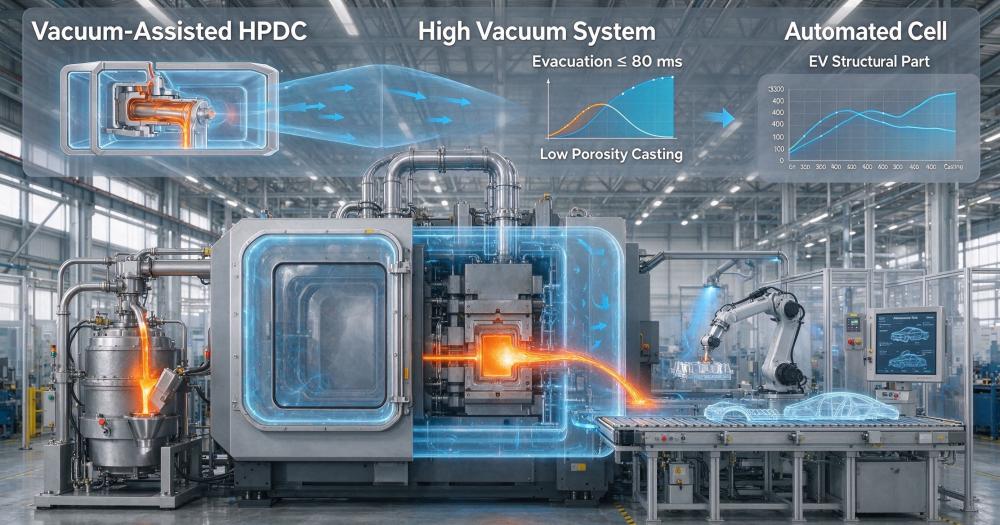
While AI gets headlines, two process technologies are reshaping what die casting can produce. Vacuum-assisted die casting has moved from niche to near-standard for safety-critical EV structures—when pore content drops by 60–80%, aluminum parts can be T6 heat-treated and laser-welded without blow-out risk.
Rheocasting is the other one to watch. After years on the periphery, it appeared at EUROGUSS 2026 with its own pavilion. Its pitch isn’t replacing high-volume HPDC, but functional integration—parts needing better strength or lower porosity than conventional HPDC can deliver, without the scale economics of a megacasting cell.
What This Means for Machine Builders and Buyers
When specifying a new cold chamber machine, the question is no longer just tonnage and shot speed. It’s whether the control system can ingest and act on data from the entire cell—vacuum, sprayer, die temperature—without a dedicated data science team. The machines that hold their value are designed for integration, not isolation. EUROGUSS 2026 reflected this: the conversation moved from “can we make big castings?” to “how do we integrate casting into the production system?” The next competitive edge won’t come from a bigger press, but a smarter one.
Industry Q&A
Q1: Is AI in die casting just hype?
Real deployments exist but are focused—mainly shot-level quality prediction. Full closed-loop AI control remains rare because cycle times are too short for human-supervised intervention, though automated parameter adjustment between shots is gaining traction.
Q2: What’s the biggest barrier to vacuum die casting?
Tooling cost. Vacuum requires modified dies, sealed ejector systems, and precise valve timing. The economics work best for large, high-volume parts where heat-treatability and weldability justify the investment.
Q3: Why is rheocasting getting attention again?
Megacasting solved the “big part” problem but left gaps in functional integration. Rheocasting offers better ductility and lower porosity for parts like steering knuckles and structural nodes—without the scale requirements of a giga-press cell.
Q4: Does recycled aluminum really work for structural castings?
Research says yes, with the right alloy design. ORNL demonstrated that an Al-Mg-Si-Fe-Mn alloy from 100% mixed sheet scrap can meet structural property requirements when composition is controlled. The challenge is industrial-scale sorting and consistency, not metallurgy.
Q5: What should I ask a machine supplier about data integration?
Ask whether the control system can synchronize data from the vacuum unit, sprayer, and die temperature controller in real time—not just log them separately. AI’s value depends entirely on whether the data reflects the whole cell or just the shot end.