



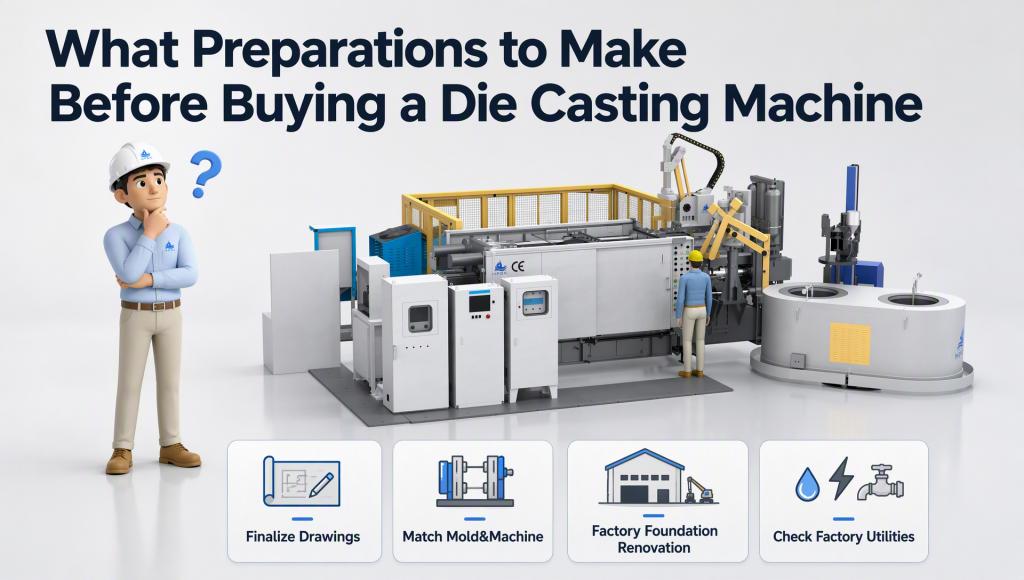
Purchasing a die casting machine is a major capital investment for manufacturing factories. Blind procurement without adequate pre-work often leads to mismatched die casting machine models, failed on-site installation, delayed production schedules and extra costs. To guarantee smooth equipment installation, stable mass production and long-term operational efficiency, manufacturers need to finish a series of standard preparations in advance. This article lists core pre-purchase steps for your die casting machine project, helping you avoid common mistakes and select equipment matching your die casting production needs.
1. Confirm Final Product Drawings & Production Requirements
Completed and finalized product drawings serve as the foundation to select a die casting machine. Do not confirm machine models based on rough drafts or unfinished parameters. You need to clarify core details: product size, wall thickness, part weight, alloy type (aluminum, zinc, magnesium alloy, etc.) and structural complexity.
Besides, sort out key production KPIs: daily output, cycle time and precision requirements. These figures directly decide the tonnage, injection speed and pressure settings of the die casting machine, supporting accurate model selection.
2. Match Die Casting Machine Model According to Mold Parameters
The die casting machine must be fully compatible with your die casting mold. Mold parameters are the core reference for model selection. Calculate required clamping force based on the casting’s projection area and injection pressure, and reserve a 10% safety margin to prevent flash and part deformation.
Meanwhile, check mold dimensions (mold height, opening stroke, platen size) against machine specs: platen size, ejector stroke and maximum mold thickness. If you plan automated die casting production, confirm whether the machine can work with peripheral devices such as automatic sprayers, part pickers and feeding systems.
3. Complete Factory Ground Foundation Renovation
Die casting machines are heavy industrial equipment with obvious operating vibration, so factory foundation renovation is a must before installation. First test the floor bearing capacity to hold the total machine weight, preventing floor settlement or equipment tilt during long run die casting production.
Follow the equipment installation drawing to pour concrete foundations, fix embedded anchor bolts and add vibration reduction treatment. Reserve proper positions for anchor bolts, drainage pipelines and hydraulic circuits. A qualified foundation cuts machine vibration, stabilizes casting quality and extends the service life of your die casting machine.
4. Inspect Factory Utilities & Space Conditions
Before machine delivery, inspect and prepare all supporting utilities. Verify stable power supply and sufficient load capacity to avoid startup failures or unstable operation. Arrange cooling water lines and compressed air pipelines to meet the cooling and pneumatic demands of the die casting machine.
Optimize workshop layout. Leave enough space for equipment installation, mold change, routine maintenance and material handling. Ensure ventilation, dust removal and environmental systems comply with die casting industry standards to run compliant production.
5. Confirm After-sales & Technical Support Plan
Die casting machine installation, commissioning and maintenance require professional technical support. Before placing the order, confirm the supplier’s on-site commissioning, operator training and after-sales response time.
Clarify warranty terms, spare parts supply channels and troubleshooting efficiency. Reliable after-sales support avoids unexpected downtime and keeps your die casting line running steadily.
6. Arrange Budget & Production Timeline
Prepare a full budget covering die casting machine cost, mold fabrication, factory renovation, utility upgrade and ongoing maintenance to prevent overspending.
Build a clear timeline, including order lead time, foundation construction, machine installation, commissioning and trial production. Ensure seamless handover between each phase to achieve on-time mass production.
Final Conclusion
Sufficient pre-purchase preparation is critical for a high-efficiency die casting production line. From product drawing validation and mold-machine matching to factory foundation upgrade and utility setup, every step influences equipment performance and production benefits. Proper pre-work helps manufacturers pick suitable die casting equipment, lower modification costs and maximize output in mass production.
FAQs
Q1: What is the most important factor to select a die casting machine?
A1: The key is matching mold parameters and casting projection area. Calculate the required clamping force and select the correct machine tonnage with safety margin for stable die casting.
Q2: Do small tonnage die casting machines still need floor renovation?
A2: Yes. Even small die casting machines generate vibration. Reinforced foundation and vibration damping prevent machine shifting and casting defects.