Request a Quote
Language : English

English

  • Market background of the casting industry in 2021
    2021-09-10

    Market background of the casting industry in 2021

    The global die casting machinery market continues steady expansion, with authoritative forecasts showing the market value grew from USD 2 billion in 2020 and is projected to reach USD 4 billion by 2026, maintaining a CAGR above 6% from 2021 to 2026. Though the industry faced temporary slowdowns during the COVID-19 period due to global supply chain disruptions and trade restrictions, recovering raw material output and rebounding manufacturing activity have fueled continuous market recovery. The core growth drivers lie in the booming lightweight vehicle industry and the widespread adoption of high-pressure die casting technology. Automotive manufacturers increasingly rely onaluminum die casting machines to produce lightweight alloy components, effectively reducing vehicle weight and energy consumption. Rising automobile sales and expanding automotive production capacity further boost market demand for professional die casting equipment. Geographically, the Asia Pacific region dominates the global die casting machine market, supported by robust manufacturing development in China, India and other emerging economies. Meanwhile, growing demand for industrial precision instruments steadily propels market growth in North America. The market is segmented by machine type into cold chamber die casting machines and hot chamber die casting machines, covering automotive, 3C electronics and other industrial sectors with aluminum and magnesium as mainstream raw materials. Stringent global carbon emission regulations and rapid electric vehicle popularization further accelerate industry upgrading. EU CO₂ reduction targets for new vehicles strongly promote lightweight aluminum alloy applications, making aluminum the most favored material in modern die casting machinery production. Driven by lightweight trends and environmental policies, the global die casting industry will maintain stable and high-quality growth in the next few years.
    Read More
  • Headline: Longhua Launches Optimized High-Precision Intelligent Energy-Saving Die-Casting Machine
    2021-08-24

    Headline: Longhua Launches Optimized High-Precision Intelligent Energy-Saving Die-Casting Machine

    Bengbu Longhua Die Casting Machine Co., Ltd. has completed comprehensive technical upgrades for its core high-precision intelligent energy-saving die-casting machine series. Optimized through independent R&D and structural innovation, the upgraded equipment features lower motor power consumption, stronger overall performance, outstanding energy-saving and emission-reduction effects, and fully complies with national industrial quality standards for die-casting machine. The upgraded hydraulic circuit is the core highlight of the new model. It effectively accelerates slow injection speed and shortens the fast injection opening stroke, realizing superior exhaust of molten metal during the die-casting process. This innovative optimization greatly reduces internal air entrapment in molten alloy, significantly enhances the compactness and structural density of finished castings, and fundamentally improves overall die-casting product quality. Adopting high-standard industrial configuration, the machine’s clamping components including static templates, movable templates, clamping cylinder bases, gantries and toggle mechanisms are forged from high-quality precision steel castings. With professional tempering and prestress treatment, these core parts deliver high strength, excellent rigidity, strong deformation resistance and fracture resistance, ensuring long-term stable high-load operation. Equipped with a high-precision full-gear mold adjustment system, the machine maintains a mold-adjustment synchronization accuracy above 1:1000 for four tie rods, realizing stable, precise and error-free mold calibration. The hydraulic-driven mechanical toggle clamping mechanism provides a 16–26 times clamping force amplification, supporting multi-level pressure and speed adjustment for mold opening and locking. Built-in low-pressure mold protection function effectively avoids mold damage and reduces production costs. In terms of injection performance, the machine adopts a piston-type nitrogen energy storage rapid pressurization system, which delivers instant high speed and powerful thrust while supporting precise PLC signal response and fine injection process tuning. The independent four-stage injection system (slow injection, first fast injection, second fast injection, pressurization) allows arbitrary adjustment of system pressure and speed, adapting to diverse casting process requirements. The dual-circuit and dual-proportion independent hydraulic system separates injection and pressurization control, featuring fast acceleration and ultra-short pressure build-up time. Benefiting from the full-process technical optimization, the product qualification rate of Longhua’s intelligent die-casting machine reaches 96.3%, far exceeding the industry average. Integrating high precision, fast response, high efficiency and remarkable energy-saving performance, the upgraded machine provides reliable, low-consumption and high-yield intelligent manufacturing solutions for ...
    Read More
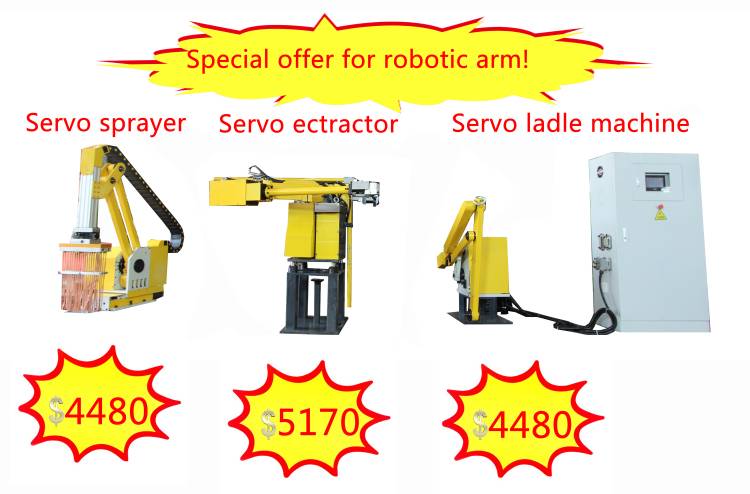
  • Special offer for robotic arm!
  • Common faults and treatment methods of die casting machines
    2021-07-27

    Common faults and treatment methods of die casting machines

    1. No feed When the manual operation hammer head moves normally, but there is no injection action when it is automatic, check the following items: Whether manual or automatic selection knob is normal. No input of mold locking signal: The mold locking termination sensor switch does not cooperate with the mold locking confirmation limit switch, and the mold locking termination sensor switch senses, but the mold locking termination confirmation limit switch is not pressed, or the limit switch is damaged. The proximity switch is damaged when the material is shot. Check if there is an electric signal for the first injection speed, return hammer oil valve, and whether the spool moves. The injection time is too short. The injection hydraulic cylinder is damaged. No pressure in hydraulic system 2. No thimble The ejection hydraulic cylinder can not realize the ejection pin action, you should first observe whether the ejection pin work indicator on the electrical box panel is on or whether the computer has a signal output 2.1 If the indicator light is off or the computer has no signal output, check: ①Whether the mold is opened in place. ②If core-pulling is installed, check whether the core-pulling is in place. ③Whether the thimble limit switch is damaged. 2.2 If the computer has a signal output, check: ①Whether the thimble pressure is normal (observe the pressure gauge). ②Whether the fourteen-way amplifier board is normal (observe whether the thimble output indicator on the fourteen-way amplifier board is on). ③Whether the circuit from the fourteen-way amplifier board to the hydraulic valve is open, and whether the oil valve coil is normal. ⑤Check whether the thimble oil valve is normal and whether the thimble hydraulic cylinder has internal leakage. ⑥The ejector pin of the mold is stuck, and the ejector pin cannot be ejected. 3. The hammer head does not return or the return hammer is not in place Remove the hammer head and the hammer head connection components, and the injection piston rod can return to the position, indicating that the punch is stuck. If the injection piston rod still cannot return after the punch is removed or the return hammer is not in place, check. Whether the return hammer in-position induction switch is damaged. Whether the return hammer valve is damaged. Whether the injection hydraulic cylinder is damaged. 4. Leakage of hydraulic cylinder The leakage of hydraulic cylinder includes external leakage and internal leakage. External leakage refers to the external leakage at the cylinder and cylinder head, cylinder bottom, oil port, exhaust valve, buffer regulating valve, cylinder head and piston rod, etc., which can be directly observed from the outside.  Internal leakage refers to the leakage of pressure oil from the high-pressure chamber inside the hydraulic cylinder to the low-pressure chamber, which occurs at the connection between the piston and the inner wall of the cylinder, the inner hole of the piston and the piston rod. ...
    Read More
  • Basic Principles of Die Casting
    2021-07-06

    Basic Principles of Die Casting

    1. Consider the injection pressure: multi‑stage injection with different functions There are four stages for injection pressure: fast pressure, filling, pressurization, and pressure holding, each with distinct functions. In the initial phase, the piston pushes molten metal into the cavity at a relatively low speed until the cavity is fully filled. Pressure holding stage:The injection punch transmits pressure to the cavity via the solidified residual material and the metal at the junction. This enables the solidifying metal to crystallize under pressure, producing castings with dense internal structure. The duration of pressure holding is mainly determined by die‑casting alloy properties, casting wall thickness, gating system and other working conditions. Cooling stage:The cooling stage covers the time from the end of pressure holding until the casting is ejected in the die‑casting cycle. Filling time:Adjust die‑casting filling time according to product geometry and wall‑thickness variation. 2. Critical die‑casting process parameters affecting casting quality Multiple parameters exert great influence on final casting quality: Residence time of molten alloy inside the shot sleeve Punch speed or punch acceleration at the start of the first‑shot phase Transition point from first‑shot to second‑shot phase (displacement stroke for each injection stage) Punch acceleration time and filling time during the mold‑filling (second‑shot) phase Boost pressure and boost time for molten metal inside cavity after filling completion Solidification time of castings within the mold cavity Derived core die‑casting process specifications include: slow injection speed, high‑speed (mold‑filling) speed, speed‑switch position, boost pressure, and cooling time. Slow injection speed:Slow injection speed should be properly controlled to avoid turbulence of molten alloy inside the shot sleeve and excessive temperature drop of molten metal. The advanced 9‑stage low‑speed control is widely adopted nowadays. It simulates uniformly‑accelerated motion and minimizes gas entrapment inside the shot chamber. High‑speed speed (secondary speed):Also known as secondary speed, it refers to punch speed during mold filling. Proper control ensures favorable atomized metal flow at the ingate during cavity filling. Reference values shall be selected based on casting structure and wall thickness, then converted into punch travel speed according to ingate dimension and shot‑chamber size. Speed‑switch position:Also called second‑speed switch position, it defines where the punch begins to accelerate. Acceleration can be triggered when the shot sleeve is fully filled, when molten alloy reaches the ingate, or after partial cavity filling. This position must be fine‑tuned according to product features and actual production defects. Boost parameters (four controllable factors):Four parameters should be managed for boost function: Start position of pressurization Pressure building time Pressure holding ...
    Read More
  • Bengbu LongHua Launches High-Efficiency Energy-Saving Die-Casting Machine, Empowering Global Manufacturers with Significant Cost Reduction and Quality Upgrade
    2021-06-25

    Bengbu LongHua Launches High-Efficiency Energy-Saving Die-Casting Machine, Empowering Global Manufacturers with Significant Cost Reduction and Quality Upgrade

    BENGBU, China – September 1, 2026 — Bengbu LongHua Die Casting Machine Co., Ltd., a national high-tech enterprise and standard setter for China’s intelligent die-casting industry, has unveiled its self-developed intelligent high-speed and high-precision energy-saving die-casting machine. Co-developed with the Hefei Institutes of Physical Science, Chinese Academy of Sciences, the patented equipment delivers comprehensive upgrades in energy conservation, production efficiency, product qualification rate and service life, providing highly cost-effective intelligent manufacturing solutions for global die-casting enterprises. LongHua’s flagship energy-saving die-casting project was officially launched at the 3rd China MEMS Intelligent Sensor Industry Development Conference in November 2019, supported by the Anhui Provincial and Bengbu Municipal governments. Listed as one of Bengbu’s four core high-end manufacturing projects, the equipment boasts 9 national invention patents, 33 utility model patents, 2 high-tech product certifications, 1 Anhui Provincial New Product Certificate and 4 software copyrights, owning completely independent intellectual property rights. Against the backdrop of rising global industrial energy consumption and production costs, LongHua’s new-generation die-casting machine solves core pain points of traditional casting equipment with eight major competitive advantages, realizing all-round cost reduction and efficiency improvement for manufacturers. In terms of energy saving and cost reduction, compared with mainstream same-tonnage die-casting machines from other domestic brands, LongHua equipment achieves a50%-80% power saving rate. Based on 24-hour continuous production, 30 days a month, it saves 10,800 kWh of electricity monthly, equivalent to an annual electricity cost saving of 129,600 CNY, greatly reducing enterprises’ daily operation expenses. The equipment features an innovative hydraulic oil temperature reduction technology, lowering operating oil temperature by about 8°C during production. This optimization extends the service life of core components including hydraulic valves, pumps, valve plates, hydraulic oil, molds, injection chambers and plunger heads by 40%, and reduces overall production costs by approximately 40% compared with peer products. In terms of production quality, the full closed-loop energy-saving hydraulic system achieves ultra-precise control of system pressure and flow. It effectively raises the qualification rate of die-casting products, eliminating the massive energy, consumable, labor and cycle waste caused by the 70% qualification rate of traditional equipment. Meanwhile, the optimized pump station structure accelerates the machine’s response speed, boosting overall production efficiency by 30% than ordinary die-casting machines. The equipment also realizes comprehensive environmental and operational upgrades. It reduces operating noise by more than 6 decibels, greatly improving the workshop wor...
    Read More

  • Do you know the cycle of die casting molds?
    2021-06-18

    Do you know the cycle of die casting molds?

    Metal die-casting is an advanced technology with less and no cutting. It has the characteristics of high consumption efficiency, saving original materials, reducing consumption costs, good casting performance, and high precision. It is widely used. Among them, the largest market for die-casting castings is the automotive industry. As humans pay more and more attention to sustainable development and environmental maintenance, automotive lightweighting is the best way to achieve high efficiency, safety, energy saving, warmth and environmental protection. Using aluminum alloy instead of traditional steel to make cars can reduce the weight of the whole car by about 30%. Because the die-casting mold is to die-cast molten metal at 400~1600℃ under high pressure (30~150MPa). During the molding process, the mold is periodically heated and cooled, and is scoured and corroded by hot metal sprayed at high speed. Mold materials require high thermal fatigue resistance, thermal conductivity, and good wear resistance, corrosion resistance, and high temperature mechanical properties. It is still difficult to meet the ever-increasing performance requirements only by the application of mold materials. Various surface treatment technologies must be applied to the surface treatment of die-casting molds to meet the requirements for high efficiency, high precision and long life of die-casting molds. Die-casting mold failure method When the die-casting mold is in contact with high-temperature liquid metal, it not only has a long time of heating, but also the heated temperature is higher than that of forging dies. The temperature of die-casting non-ferrous metals is 300~800℃, and the temperature of die-casting ferrous metals is above 1000℃. It also received a very high pressure of 30-150 MPa, and was subjected to wear and corrosion caused by repeated heating and cooling and high-speed scouring of liquid metal activities.
    Read More
  • Sales of new energy vehicles increasing sharply, and aluminum alloys usher in new opportunities
    2021-06-01

    Sales of new energy vehicles increasing sharply, and aluminum alloys usher in new opportunities

    The rapid development of the new energy vehicle industry has created huge market opportunities for the aluminum die casting machine sector, driving continuous upgrading and innovation of global die casting equipment. Though new energy vehicle technology is still evolving, its core advantages in energy saving, emission reduction and environmental protection ensure long-term industrial growth, bringing unprecedented development momentum to the die casting machinery manufacturing industry. Driven by national energy conservation policies and financial subsidies, the new energy vehicle market has achieved explosive growth. Industry data shows that new energy vehicle sales exceeded 1.03 million units before November 2018, with a year-on-year increase of 68%, marking the official takeoff of the domestic new energy automotive market. This booming trend greatly boosts market demand for high-performance aluminum die casting machine, as aluminum alloy has become the core lightweight material for new energy vehicles. Aluminum alloy features low density, light weight, excellent corrosion resistance, high plasticity and stable strength, perfectly meeting the lightweight manufacturing needs of new energy vehicles. It is widely applied in auto bodies, engine parts, chassis, suspensions, wheel hubs, heat exchangers and battery components. With expanding aluminum alloy application scenarios, the market demand for precision die casting equipment continues to surge. However, aluminum alloy processing faces technical challenges compared with traditional steel processing. Complex processing techniques raise production difficulties, and unqualified casting processing will affect vehicle safety and stability. As a professional die casting machinery manufacturer, Longhua focuses on optimizing aluminum die casting technology and equipment performance. It provides high-precision, stable aluminum die casting machine solutions for automotive lightweight production, helping the new energy vehicle industry achieve high-quality and sustainable development.
    Read More
first page 21 22 23 24 25 26 27 28 29 30 last page

A total of 37 pages

leave a message leave a message
If you are interested in our products and want to know more details,please leave a message here,we will reply you as soon as we can.
Home

Products

News

Contact